
Imagine walking into a school where not a single student is glued to a smartphone. Instead of heads bent over screens, you see eye contact, group discussions, and even a few kids tossing a football around. This scene is becoming reality as schools across the country ban student cell phones and electronic devices during the school day. For parents and students, this new policy can feel like a big adjustment. Why are schools doing this? Is it actually a good thing? In this in-depth look, we’ll explore what phone bans mean for families, how they can boost academic performance, improve mental and social health, and reduce distractions, as well as practical tips for parents and students to smoothly navigate a phone-free school life.
Why Are Schools Banning Student Phones?
Not long ago, the idea of banning phones in schools seemed extreme. Today it’s a full-blown movement. Educators nationwide report that smartphones have become a major distraction and even a threat to a healthy learning environment. In fact, over half of public school leaders (53%) believe that student cell phone use is harming academic performance, and approximately 72%–73% think that phones negatively impact students’ mental health and attention spans. With evidence mounting that constant notifications and social media are taking a toll on kids’ ability to focus, many schools have decided that enough is enough.
Parents, teachers, and lawmakers are increasingly on the same page. A recent Pew Research survey found that roughly two-thirds of Americans believe phone-free schools would improve students’ social skills, grades, and behavior. Support for strict policies is rising each year. As of 2024, 15 states had passed laws to ban or restrict student phone use in schools, and by mid-2025, that number had grown to 21 states (including Virginia, most recently) that limit or prohibit phones in K-12 schools. Even major districts like Los Angeles Unified (the second-largest in the U.S.) rolled out a “bell-to-bell” phone-free policy, meaning from the first bell of the day to the last, student devices stay put away. This trend spans both red and blue states, as leaders share a common goal of keeping students engaged in class.
Why the clampdown? Teachers have long observed that phones in class lead to zero attention and constant disruptions. As one high school teacher put it, “If the phone is in their hands, there is zero engagement, zero focus. It’s not just texting—social media, games, YouTube, even live sports streams have been competing with classroom instruction. Educators were fed up with being the “phone police” instead of doing their job to teach. Now, with school-wide and even statewide bans, teachers finally feel backed up by clear rules. “Our number one job is creating a sound learning environment. Cellphones were making that impossible,” said one teacher advocate of a district ban. By removing the constant temptation of a device, schools hope to restore calm and focus in hallways and classrooms.

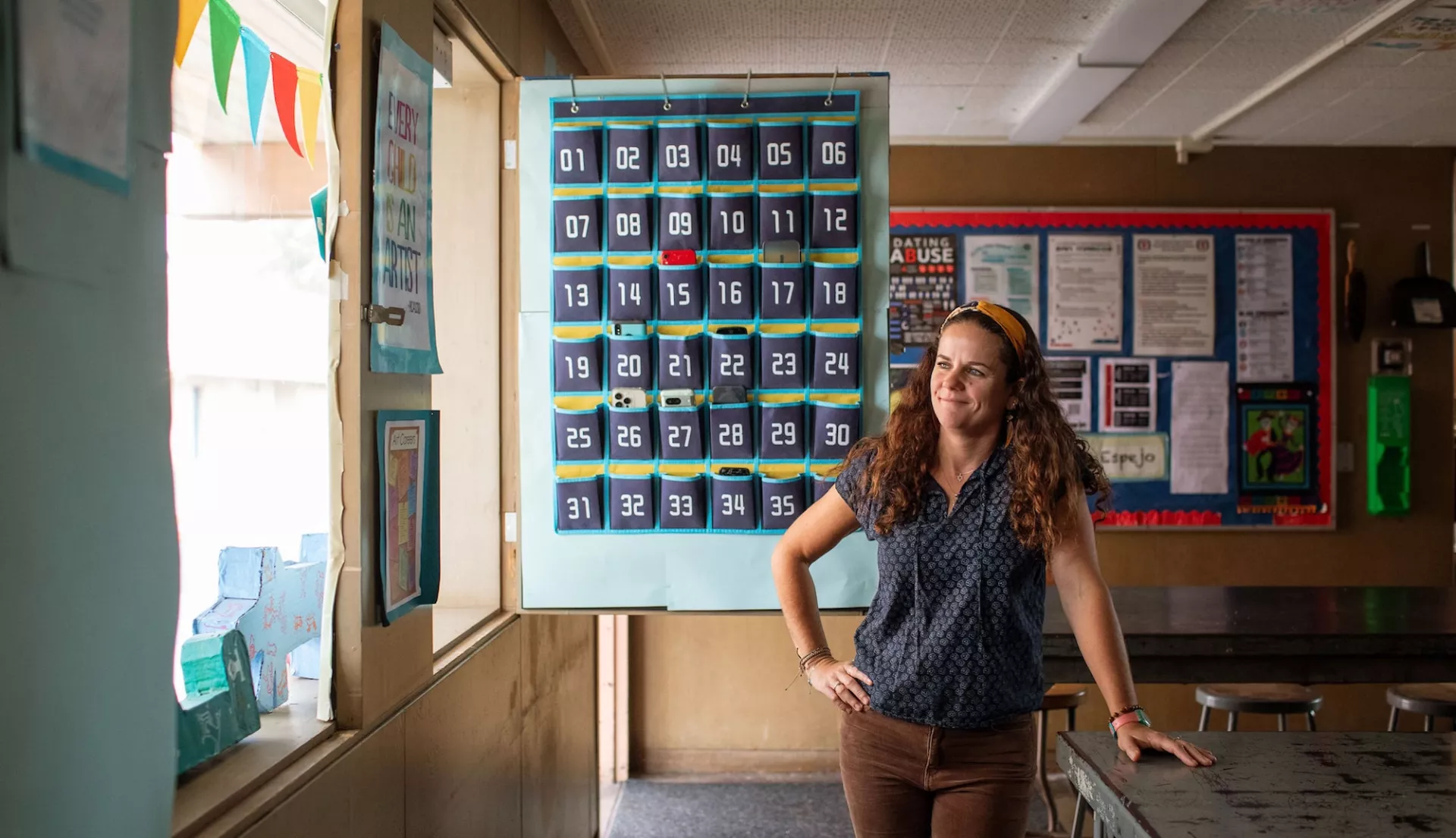
High school teachers are using “cell phone hotels” – pocketed wall hangers where students must park their phones at the start of class. Making devices out-of-sight and out-of-mind helps everyone focus on learning. (Photo: Sara Prince, NEA Today)
The push for phone-free schools isn’t just top-down from school officials; it’s also a grassroots parent and teacher-led movement. Many parents have grown alarmed at how omnipresent smartphones and social media are in their children’s lives. Parent advocacy groups with names like “Smartphone Free Childhood” and “Mothers Against Media Addiction” are campaigning alongside educators for device restrictions during school hours. The message is that smartphones are siphoning away the play, socialization, and attentiveness that are key to healthy childhood development, and school is the one place we can reliably turn the tide. The result? Policies that would have been unthinkable a few years ago are now being enacted at lightning speed. “Two years ago, banning phones in schools seemed almost unthinkable. Now support for phone-free schools is rising quickly,” reports TIME, noting that 74% of U.S. adults support prohibiting phones in class. Even students acknowledge the downside of their phone habit—many teens freely admit they’re “fairly addicted” to their devices and that social media use “negatively impacts [their] health and learning experience,” as one high school senior told a local newspaper. In short, the consensus is growing that phones at school do more harm than good, and removing them (at least for the school day) can bring significant benefits.
Let’s break down those benefits. How does keeping phones out of kids’ hands from 8 AM to 3 PM make a difference? Below, we highlight the positive impacts on academics, mental well-being, social life, and even how it can influence habits at home.
Academic Performance: Focus and Grades Improve
One of the biggest motivations behind phone bans is the promise of better grades and stronger academic performance. It’s easy to see why: if students aren’t sneaking peeks at Snapchat or texting under their desks, they can actually pay attention to the lesson. Classrooms without phones are noticeably calmer and more focused, according to teachers. In Seattle, after a middle school instituted a strict phone ban, educators reported “fewer disciplinary issues, less disruption in classrooms, and more time for instruction”. Without the constant interruptions of buzzing notifications, teachers in that school said they gained back over 10 minutes of teaching time per class period that used to be lost corralling phone distractions. Ten minutes here and there adds up – that’s an extra hour of learning per week for each class!
Research is beginning to back up these anecdotal improvements with hard data. In one notable analysis, schools in four UK cities that banned cell phones saw significant increases in student test scores, with the biggest improvements among struggling students. Similarly, a recent study by the Yondr pouch company (which makes locking phone pouches for schools) examined over 37,000 student grades before and after a phone ban. The results were eye-opening: student academic success rates went up by about 6.3% after implementing the no-phone policy, and there was a 38% increase in the probability of students earning passing grades in core classes for 11th and 12th graders. In other words, removing the phone distraction helped many borderline students regain their footing and pass their courses. That same study also documented a 44% drop in average monthly behavior referrals after phones were restricted, indicating calmer classrooms. Nearly three-quarters of teachers (74%) reported that students were more attentive and engaged after the ban.
Even at younger ages, schools report scholastic benefits. One Connecticut middle school that implemented locked pouches experienced a dramatic 50% decrease in daily office discipline referrals and approximately 30–40% fewer suspensions after adopting a phone-free policy. It wasn’t just phone-related mischief that decreased – all behavior issues declined, which the principal attributed to the new focus and calm created by taking devices out of the equation. With fewer disruptions, students can better absorb material and participate, ultimately reflecting in their grades and test outcomes.
Why such a big academic boost? It comes down to attention. Smartphones are designed to capture your attention – and hold it. For a teen in math class, a buzzing phone is almost irresistible, and one quick glance can spiral into minutes of lost focus. If this happens dozens of times a day, it severely fragments a student’s concentration. By banning phones, schools remove this temptation and help students sustain their attention on schoolwork. Teachers no longer have to compete with TikTok or text messages for students’ brainpower. As one science teacher observed, when the phone is put away, students re-engage: without a device in hand, there’s “zero engagement, zero focus” on anything else but the lesson. Over a semester or year, that improved focus translates to more learning.
Additionally, without phones, students are less likely to cheat or engage in multitasking during class. The internet at their fingertips can be a shortcut to copying answers or Googling during a quiz. A phone ban levels the playing field and promotes academic honesty. It also forces students to develop note-taking skills and memory retention rather than relying on snapping a picture of the board or texting a friend for help.
Finally, consider homework and study time. If students get used to not having their phone during the school day, they might find it easier to put it aside when doing homework in the afternoon. Some schools report that after a phone ban, students are building better study habits – they’re more likely to read or do assignments during free periods since scrolling Instagram isn’t an option. All these factors combine to support one overarching finding: when students aren’t distracted by personal devices, they perform better academically.
Mental and Emotional Health Benefits
Beyond grades and test scores, educators are also concerned about students’ mental health – and here, too, phone bans may bring positive effects. Teen anxiety, depression, and stress have been on the rise over the past decade, a trend many experts link partly to the explosion of smartphones and social media use among kids. The school day, with its social pressures and academic demands, can become even more intense when group chats, Instagram, and TikTok are constantly in the mix. By giving students a break from their phones, schools hope also to give their minds a breather.
Studies suggest this is a reasonable hope. Research from Europe has suggested that phone-free schools may lead to mental health benefits – for example, a study of Norwegian middle schools found that banning smartphones resulted in reduced bullying (for both boys and girls) and fewer students seeking help for psychological issues. In that study, girls in particular saw a boost in well-being and even a bump in GPA after the phone ban, showing how entwined social-emotional health and academics can be. When phones – and by extension, social media drama – were removed from school hours, students felt less social pressure and conflict, which likely contributed to those improvements.
Even without formal studies, many teachers observe a calmer emotional climate once phones are out of the picture. Middle school counselors say they witness “so much more joy and connection” among students after a phone ban, with kids being kids again instead of acting like mini social media addicts. Freed from the urge to constantly check likes or messages, students can relax and be present. One surprising feedback from students in a phone-free school was a sense of relief – they didn’t have to keep up with group chats or online gossip during the day, which actually lowered their stress. “Students have reported feeling a sense of relief and a renewed ability to engage in real-life interactions without the constant pull of their screens,” notes an education report on schools limiting devices. For some kids, not having their phone at school is like lifting a weight off their shoulders – suddenly it’s okay to not reply immediately, to not see every post, to just breathe and focus on what’s in front of them.
On the flip side, it’s true that some students initially feel anxious when separated from their phones. They might worry they’re missing out on something or feel odd without that digital security blanket. This is understandable – many teens have never known school without a smartphone in their pocket. The good news is that this discomfort usually fades as new habits form. Schools can help by reassuring students that if something truly important happens online, they’ll find out later, and by fostering inclusive, engaging activities (like clubs, games, or conversations at lunch) so no one dwells on their device. It’s also worth noting that in serious situations like emergencies, having a hundred teens dialing and scrolling on phones may actually heighten chaos and anxiety. Safety experts say in a crisis, students should follow the teacher’s instructions, stay quiet, and not all be on their phones. So removing phones can actually make school feel safer and calmer for students, not just in day-to-day routines but even in rare critical moments.
Critically, reducing screen time at school helps cut down exposure to the negative aspects of social media during the school day – things like cyberbullying, comparison-driven anxiety, or seeing distressing content. A large body of research has found that the more time kids spend on smartphones, the higher the risk of depression and other negative mental health outcomes. By carving out a chunk of the day that is screen-free, schools are essentially scheduling a healthy “digital detox” for students each day. Over time, those hours free of curated Instagram feeds and viral TikTok videos can help students reconnect with reality and with each other, hopefully fostering more resilience against the online stresses they face off campus.
Finally, let’s not forget sleep and downtime, which are indirectly linked to phone use. Students who are less tied to their phones at school may start to break the habit of incessant phone-checking, which can carry over to nighttime. Constant phone use, especially at night, has been linked to sleep problems in teens. An environment that normalizes putting the phone away might encourage kids to unplug earlier in the evenings, leading to better rest and a better mood and mindset the next day.
In summary, while phone bans aren’t a silver bullet for all mental health challenges, they do remove a significant source of stress and distraction. Less social media and texting during school equals fewer opportunities for drama and more headspace for learning and interacting in person, which is a recipe for a healthier school experience. As one teacher noted about social media’s impact in class, the biggest issue wasn’t even the content, but “the constant disruptions to learning” it caused. Tackling that disruption is a necessary first step toward a more supportive mental and emotional environment at school.
Social Skills and School Culture
Another clear benefit of phone-free schools shows up in the social lives and skills of students. Think about the typical school scene in recent years: lunch tables full of teenagers, all staring at their individual screens; hallways where students text each other while walking; groups of friends scrolling TikTok videos in silence. When schools ban phones, that scene changes dramatically – and for the better. Students start talking to each other, playing together, and engaging in face-to-face interactions again.
Teachers frequently report that phone bans “shift the culture” of a school. The middle school in Seattle mentioned earlier saw kids flooding back to the library, game tables, and sports fields during lunch once they couldn’t use phones. Instead of retreating into Instagram, students were emceeing music trivia games, playing ping-pong, and actually mingling across groups. One counselor gushed that the policy “has truly shifted the culture of school and the ability for our kids to be kids… There is so much more joy and connection.”. That kind of joyful social energy is hard to foster when every student is wrapped up in their own digital bubble.
Without phones, students practice conversation, cooperation, and friendship-building in real life. They pay attention to who’s in front of them, not who’s on their screen. Over time, this can improve communication skills and empathy. It’s much easier to sense if a classmate is having a bad day or needs help when everyone’s eyes are up, rather than buried in phones. Being present in the moment allows students to develop stronger interpersonal skills, which will benefit them far beyond school – in jobs, relationships, and community life.
There are other social benefits too. Disciplinary issues like fights or bullying tend to decrease in a phone-free environment. One reason is that without phones, incidents don’t get amplified through recordings or social media in the moment. Teachers noted that disagreements, which might have “escalated into full-fledged fights when the phones came out to capture videos, now fizzle out faster”. Students are less inclined to show off or act out for an online audience when there’s no immediate online audience. And bullies lose a tool – they can’t harass someone via text or photo during school hours. This helps create a safer, more inclusive atmosphere.
Additionally, taking phones out of the equation levels social status to a degree. In a world where the type of phone or the number of social media followers can create social hierarchies, a phone ban makes those differences invisible at school. No one’s flashing the latest iPhone or obsessing over who got more likes on a post during the school day. Students relate to each other more directly, as peers in the same shared space, not as curated online personas.
It’s also worth mentioning the value of boredom – yes, boredom! When kids have phones, any idle moment is filled with mindless scrolling. Remove phones, and guess what? Kids get a little bored sometimes… and then they get creative. They tell jokes, daydream, start impromptu games, or actually pay attention in study hall. Developmental psychologists note that some boredom is healthy for kids because it spurs imagination and initiative. By not providing an endless stream of digital entertainment, phone-free schools nudge students to create their own fun and social connections.
Overall, the social payoff of banning phones is a school where students feel more connected to each other and to the school community. They cheer each other on in gym instead of filming from the sidelines. They notice new classmates and make new friends more readily. Teachers and principals often say a phone ban makes the school feel “more like a family” and less like a collection of isolated individuals. Given how crucial social skills and a sense of belonging are to a student’s development (and mental health), these cultural changes are a huge win.
At Home: Extending the Benefits Beyond School
You might be wondering, does a phone ban at school really matter if kids just binge on their devices once they get home? It’s a fair question. While the school’s authority ends at the final bell, the habits and attitudes students develop during the day can indeed spill over into their home life – especially with support from parents.
First, when a school enforces responsible tech use, it sends a powerful message that can reinforce what parents have been saying at home all along. Many parents struggle to limit their children’s screen time. Knowing that “phones are off while school’s on” by rule gives families a reference point. Students see that adults universally agree on this boundary, which can make them more receptive to screen limits at home, too. If a teen hears at school that constant phone use is harmful and then hears the same from their parents at dinner, it starts to sink in as a shared value, not just “Mom or Dad nagging.”
Some schools actively involve parents in this culture shift. They provide education for families about healthy digital habits, highlighting that the phone-free school policy is part of a bigger picture of helping kids thrive. For example, California’s state superintendent noted that schools are guiding parents to delay giving kids smartphones until high school and to keep kids off social media until at least age 16. The idea is to “bridge the divide” by getting parents on board with these norms at home. Schools share research about how excessive phone use ties into anxiety, depression, and cyberbullying, and by showcasing improvements like better grades and attendance with less phone use, they encourage parental buy-in. When parents see that reduced phone time equals happier, more successful kids, it’s a strong incentive to enforce those rules beyond school.
There’s also the simple fact that if a child isn’t on their phone all day, they may be less “hooked” on it when they get home. They’ve spent hours engaging in-person, concentrating on work, and finding other ways to occupy themselves. Certainly, many kids will race to check messages once they’re dismissed, but over time, they may find the constant scroll a bit less compelling. Some educators note students becoming more selective about when they truly need their phone. They might use it briefly after school to catch up, then put it down to go outside or work on a hobby, having rediscovered during the school day that life without a phone isn’t so bad (and can even be fun).
Families can also leverage the school’s policy to set parallel expectations at home. For instance, if phones must be away during class, perhaps parents decide that phones should be away during homework time or family dinners. The consistency makes it easier for students to accept; it’s just “the way things are” both at school and at home. One teacher noted that many parents secretly appreciate the school ban because “parents are struggling with monitoring these devices at home, so they know what we are dealing with” and are relieved that the school is helping shoulder the burden. In Santa Barbara, where a district-wide phone restriction was implemented, school staff said parents were largely supportive — they liked that the school had systems for emergencies and that their kids weren’t sneaking screen time during class anymore.
In essence, a phone-free school day can be the start of a healthier relationship with technology overall. It creates space for kids to experience life beyond the screen and proves to them (and their parents) that yes, they can survive without constant phone access. This realization is key. When a student comes home and says, “You know, not having my phone at school wasn’t as bad as I thought,” that’s a perfect opening for a parent to reply, “Great! Let’s keep that going a bit while you do homework, and then you can have your phone later.” Step by step, the benefits extend into evenings and weekends. Families might see more conversations, more outdoor play, or at least a bit less conflict over screen time.
To be clear, home life is full of variables, and phone habits won’t transform overnight just because of a school rule. But the school policy sets a precedent. It gives parents and kids a trial run of a phone-light lifestyle, at least for part of the day, and often they find it’s actually quite positive. Some parents even report that their children seem less moody or stressed after a phone-free day, as if a weight has lifted (no drama blowing up their phone, no pressure to post or respond constantly). Savvy parents can capitalize on this by reinforcing those positives: “You seem to be in a great mood after school these days – maybe not checking your phone all day is helping?” Such conversations help teens make the connection between less screen time and feeling better or doing better. That understanding is the ultimate goal: that young people learn to self-regulate their device use in a healthy way. The school phone ban is an external control, but it can nurture internal habits of balance and moderation that kids carry forward.
How Parents Can Support a Phone-Free School Policy
As a parent, you might have mixed feelings about these new phone rules. On one hand, you’re probably relieved that your child won’t be glued to TikTok in algebra class – on the other, you may worry about being unable to reach them, or how they’ll handle the change. Supporting your child (and the school) through this transition is key. Here are some tips for parents to cope with and even embrace the no-phone school day:
-
Get on Board with the Why: First, make sure you understand why the school is banning phones. Read the school’s policy and any literature they’ve provided. When you talk to your child, frame the ban positively – for example, “The school wants you to be able to focus and have a break from the drama. It’s going to help you learn and not worry about online stuff for a few hours.” Emphasize the benefits (better grades, less stress, more time with friends in person) rather than just saying “Well, those are the rules.” If you show support for the policy, your child is more likely to accept it too.
-
Plan for Communication and Emergencies: One of the biggest parent worries is “How will I contact my child if…?” Rest assured, schools have thought of this. Get familiar with the school’s procedures for communication. Typically, if there’s an emergency or you need to reach your child, you can call the school office, and they will relay a message or let your child call you from a school phone. Make sure your child knows this too: “If you need me, you can always ask to use the office phone or a classroom phone.” Some schools allow phones to be kept in lockers or backpacks but turned off – if that’s the case, ensure your child knows when it’s okay to check it (e.g., after the final bell). Having a family emergency plan (like calling the school or a designated person) will ease both your and your child’s anxieties about not having immediate cell access. Remember, experts say that during a real emergency at school, students using phones can actually interfere with safety procedures. It’s counterintuitive, but not being on the phone is safer. Trust that the school will contact you if needed.
-
Encourage Alternatives to Phone Use: Help your child find ways to fill the time that they used to fill with their phone. For example, if they usually listen to music on their phone on the bus or during a free period, consider letting them use an old iPod or a simple MP3 player (if the school permits those) or download music to a school-issued laptop if that’s an option. If they read e-books on their phone, get them physical books or an e-reader without distracting apps. Encourage them to carry a paperback for downtime. Equip them with a watch or alarm clock if they rely on their phone for the time or waking up. Basically, show them that for every function their phone served, there’s a low-tech replacement. This can actually be a fun problem-solving activity to do together.
-
Align Home Rules with School Rules: Consistency helps solidify habits. Consider mirroring the school’s phone policy at home during certain hours. For instance, during homework time or dinner, have a mini “phone-free zone” similar to school. You might say, “Since you don’t use your phone from 8 to 3 at school, we’ll also put phones away from 6 to 7 while we eat and catch up on the day.” This reinforces the idea that there’s a time for devices and a time for focus or family. It also prevents a scenario where your child sprints to their phone after school and binge-uses it for hours to “make up” for lost time. By setting reasonable limits (perhaps they do homework for an hour without phone, then get some phone time later), you extend the benefits of focus and balance into their evening routine.
-
Stay Positive and Patient: Change can be hard, and your child might complain at first – “It’s not fair!”, “I miss my phone, I feel stressed without it.” Acknowledge their feelings (change is always a bit uncomfortable) but reinforce the positives. Share any observations you have: “I notice you get your homework done faster without multitasking on your phone,” or “You seemed happy hanging out with friends after school today – maybe because you were actually talking instead of everyone on their phones.” Also, be patient. Habits won’t change overnight. Celebrate small wins, like your child saying they had an interesting conversation at lunch or they felt more focused in class. If your child is really anxious without their phone, help them come up with coping strategies (some families do a gradual wean – like turning off the phone ringer for a few hours at home to practice, or mindfulness exercises to handle urges to check the phone).
-
Communicate with Teachers and Staff: If you have concerns, reach out to the school. Educators want parents as partners in this effort. They can explain how they handle situations like students needing to call home, and they can keep you informed on how your child is adjusting. For example, a teacher might let you know, “I noticed Sarah seems a bit anxious without her phone; we’re encouraging her to join the board game club at lunch to take her mind off it.” This kind of communication can clue you in on how to support your child better at home. Likewise, if you notice a positive change – maybe your child is sleeping better or seems less stressed – let the school know. Positive feedback can help schools continue to refine and maintain these policies with confidence.
By taking these steps, parents can turn a potentially challenging change into a growth opportunity for their kids. Remember that ultimately, you, the school, and the teachers share the same goal: your child’s success and well-being. Presenting a united front on the value of unplugging during school will make it much easier for your teen to adapt. And who knows – you might find you feel a bit more at ease during the day, not expecting constant texts from your child! Many parents eventually come to love the phone ban, noting that their kids are more engaged and present when they come home. As one teacher quipped, if some skeptical parents could sit through a class with phones allowed and then one with phones banned, “they would endorse it” in a heartbeat.
Helping Students Adapt to a Phone-Free School Day
Now, let’s talk directly to the students. If you’re a student facing a new phone ban, you might be thinking: This stinks! It’s okay to feel that way at first. Phones have been your connection to friends, entertainment, and maybe your safety net during awkward moments. Losing access during school hours can feel like a big deal. But you might be surprised – it can also be really refreshing. Here are some tips to help you cope with (and even benefit from) a phone-free school day:
-
Understand the Upside: It’s easy to focus on what you’re losing (Instagram! texts! games!). Try to notice what you gain. Without a phone, you might find it easier to concentrate on classes and finish classwork in school (meaning less homework later). You’ll be more present with friends – no more half-listening while you scroll. And you get a break from the drama and pressure of constantly being online. Many students say they feel less stressed when they aren’t constantly checking their phones. Give it a chance and see if you feel a little more relaxed or free by midday when you haven’t been bombarded by notifications.
-
Stay Connected (In Real Life): Use this opportunity to actually talk to people around you. During lunch or between classes, start a conversation, join an activity, or simply chill with friends without the urge to document it. You might be surprised at how much more fun you have. At one phone-free school, students started doing trivia games and sports at lunch and said there was “so much more joy and connection.” Without phones, you can laugh out loud instead of via emojis, and nobody is going to ignore you for a screen. If you’re shy or not sure what to do, remember a lot of people are in the same boat now – even just saying “Hi” to someone in homeroom or commenting on the class can spark a real conversation.
-
Keep Yourself Busy: If you usually pull out your phone when you’re bored, plan for those moments. Bring a book or a comic you enjoy. Doodle in a sketchpad. If your school allows, bring a small puzzle, a Rubik’s cube, or a notebook to write stories or journal in. Some students carry a deck of cards or a fidget toy. By having an alternate activity, you won’t feel the phone’s absence as much. Also, take advantage of school resources: maybe the library is open, or there are clubs and games available during free periods. Challenge yourself to try one new activity – join that pickup basketball game, check out the chess club, or just take a walk around campus with a friend. Physical activity or face-to-face socializing will make you forget about your phone for a while.
-
Use Tech on Your Terms: You might not have your personal phone, but schools often have tech available for learning – like computers or tablets for classwork. When you do use those, try to stay focused on the task (since you can’t really check your socials on school devices anyway). If you feel the itch to go online for non-school stuff, jot down what you want to do and decide to check it after school. It can wait! You’ll realize most of those notifications or memes aren’t urgent at all. If something truly important is happening (say, you’re expecting news about something), talk to a teacher – they can always facilitate an important call or let you know if you need to be aware of something.
-
Mind Your Mood: It’s normal to experience a bit of FOMO (fear of missing out) at first. You might wonder if friends are chatting without you or if you’re missing a trending topic. Remind yourself that everyone else at school is in the same situation. And anything happening online will still be there later. Use school as a time to give your mind a rest from the online noise. If you start feeling anxious, take a few deep breaths. Focus on what’s around you – the classroom, the people, the here-and-now. Sometimes it helps to imagine your phone is off, not because you can’t use it, but because you don’t need to use it right now. You’re busy living your life! After a while, not checking your phone constantly will feel normal. Many students come to prefer the freedom and calm they feel being unplugged for a few hours each day.
-
After-School Balance: When the bell rings and you do get your phone back, you might feel an urge to binge on it. Try not to go overboard. Check in with your online world, but also pay attention to how you feel. Maybe catch up on messages, scroll a bit, but notice if it starts making you tense or if an hour flies by. Remember, you did just fine without it all day. Carry that confidence forward – you are in control of the phone, not the other way around. Maybe set a little routine: say hi to your friends online, then do homework or go to practice, then later you can game or scroll guilt-free. You’ll likely find you can enjoy your phone more when it’s not attached to your hand 24/7.
Above all, keep an open mind. A phone ban might sound like a punishment, but it can truly be a gift in disguise. You might focus better, make new friends, or simply feel a bit of peace from not being “on” all day. Give yourself a chance to experience school unplugged – you can always dive back into the digital world after 3 PM. Who knows, you might start to see your phone as just one of many fun parts of life, rather than everything. And that balance will help you not just in school, but in whatever you do next.
The move to ban student cell phones during the school day marks a big change in the daily rhythm of education – for students, parents, and teachers alike. Change can be challenging, but as we’ve explored, there are compelling reasons behind this trend and significant benefits to be reaped. From sharper focus and better grades to healthier minds and richer social interactions, phone-free schools aim to reclaim what smartphones have been unintentionally stealing from our kids: their full attention and engagement in the present moment.
For parents and educators, the key is collaboration and consistency. When the adults in a child’s life agree that boundaries on technology are for the best, the child is more likely to accept and even appreciate those boundaries. At the end of the day, everyone shares the same goal – helping students succeed academically and personally. If banning phones for a few hours each day can boost a student’s concentration, reduce their anxiety, improve their friendships, and enhance the classroom environment, then it’s a change well worth supporting.
The first few weeks of a new phone policy might be an adjustment period. There will be forgotten phones, sneaky peek attempts, and maybe some grumbling. But stick with it. Schools report that after the initial hump, the “new normal” of a phone-free school day feels, well, normal – and surprisingly liberating. Classrooms hum with activity, hallways echo with real conversation, and home life gets a bit less tethered to the screen. One teacher who saw the transformation noted, “If parents could see the difference, they would immediately get on board.” In many cases, they have – parents, teachers, and students are increasingly united in wanting healthier boundaries with technology.
So if your child’s school (or your school, if you’re a student) is implementing a phone ban, take heart. It’s not about punishment or trust; it’s about giving students the best possible environment to learn and grow. By removing a source of distraction and stress, we make room for more learning, laughter, and personal connection. And that’s something we can all cheer for.
In the end, the phones will still be there after school – but childhood and education only happen once. It makes sense to spend that time wisely: eyes up, minds on, and phones away. The results, as we’ve seen, are well worth it.